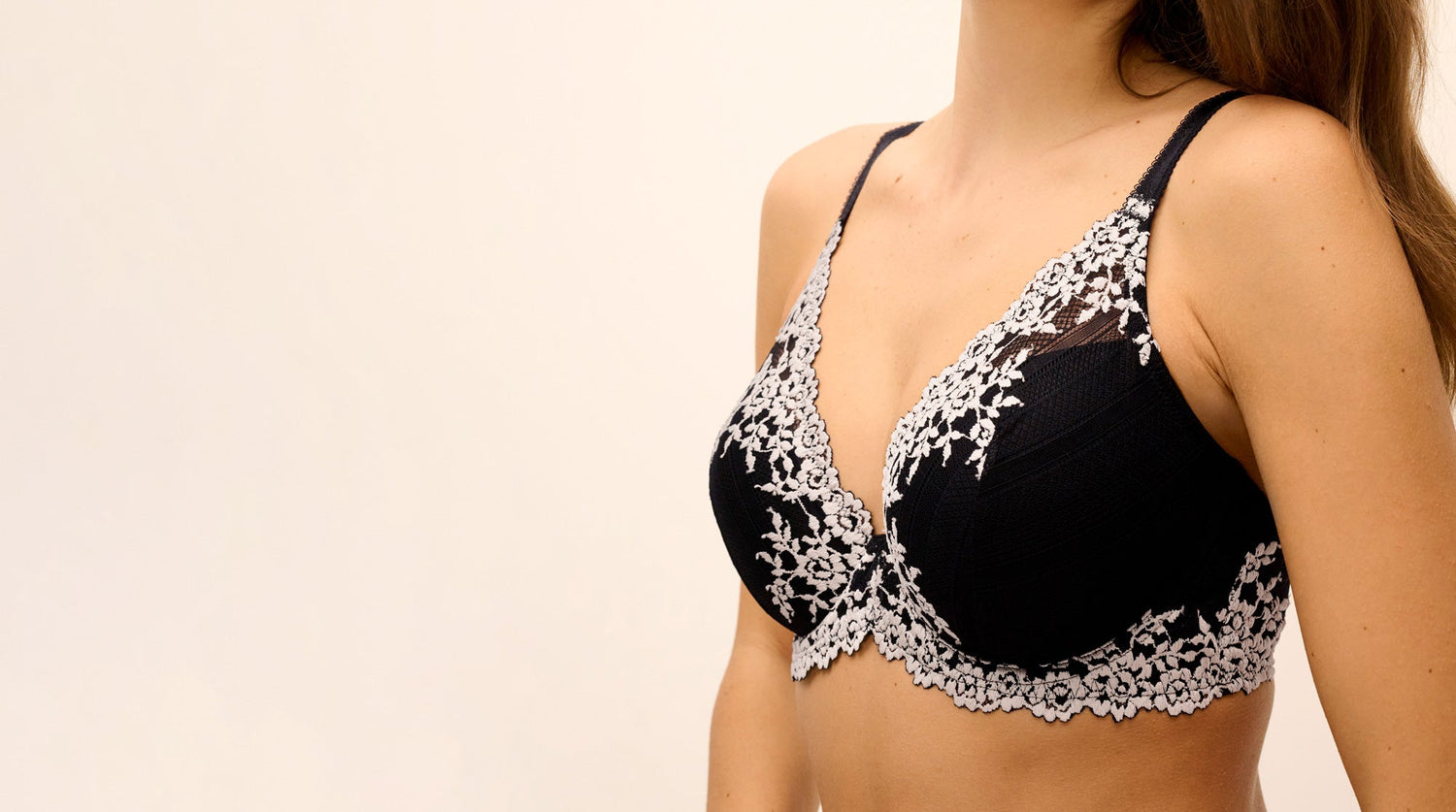
If you’ve ever put on a V-neck dress and immediately noticed your bra sitting too high in the centre, you’ve already met the problem a plunge bra is designed to solve. So, what is a plunge bra? It’s a bra with a lower centre front (the gore) and cups shaped to support while staying discreet under lower necklines.
A plunge bra is built for V-necks, wrap tops and lower necklines because the centre sits lower than most everyday bras. The best plunge bra still feels stable: a firm band, smooth cups, and a centre that sits neatly without floating. In our store, we fit plunge styles across a wide size range and help customers choose the right plunge cut for their shape - because “plunge” is a neckline style, not one universal fit. If you want the simplest rule: choose plunge for necklines first, then confirm the fit by checking band stability and cup containment.

Pictured: Full Cup Bra (Left) and Plunge Bra (Right)
What makes a plunge bra different from other bras?
A plunge bra is defined by geometry. The centre front is lower, which helps it disappear under low or narrow V shapes. But the cups still need to support - so a well-designed plunge bra balances:
-
a low centre gore
-
supportive cup structure
-
a stable band that anchors everything
That’s why a plunge bra can feel amazing when it’s right - and frustrating when it’s not.

Who should wear a plunge bra?
Plunge bras aren’t only for “cleavage” outfits. We see customers choose them for very practical reasons:
-
You wear V-neck tops, wrap dresses, or lower necklines and want the bra to stay hidden.
-
You prefer a bra that feels less closed-in at the neckline than a full cup.
-
You want a shape that sits neatly under fitted clothing without showing at the centre.
Plunge bras can work across many sizes, but the key is choosing the right plunge cut for your shape (some plunges are more open, others are more supportive).
When a plunge bra might not be the best everyday choice
Plunge is brilliant for the right outfits, but it isn’t the answer for everyone, every day.
You might prefer a different style if:
-
you want maximum coverage and containment all the time
-
you’re very full on top and find open necklines cut in easily
-
you want a bra that feels “set and forget” with more coverage at the centre
In those cases, you can still keep a plunge bra for V-neck outfits, and wear a different cut as your daily staple.
Plunge bra vs balconette vs demi: what’s the difference?
These three are often mixed up because they can all look “lower” than a full cup - but they solve different problems.
Plunge bra:
-
low centre gore (best for V-necks)
-
designed to sit lower in the middle
Balconette/demi:
-
more open cup line across the top
-
often more horizontal neckline
-
not necessarily low in the centre
A helpful way to think about it: plunge is about the centre, while demi/balconette is about the cup edge and neckline shape.

Our quick plunge bra fit checklist
If you’re trying on a plunge bra at home, here’s what we suggest checking. If any of these are off, don’t assume “plunge doesn’t suit me” - it’s often one small adjustment.
-
Band: firm and level (most support comes from here).
-
Cups: smooth, no gaping or cutting in.
-
Centre gore: sits neatly and feels stable (low, but not floating).
-
Wires: sit around breast tissue, not on it.
-
Straps: supportive, but not doing all the work.
Common plunge bra problems (and what they usually mean)
“The centre doesn’t sit flat.”
Often the cup is too small.
“I’m spilling out at the top.”
Usually a cup size issue (or you need a plunge with a different cup shape).
“The band rides up.”
Typically the band is too big. The band is the anchor - if it moves, the whole bra moves.
“I’m adjusting all day.”
That’s a fit mismatch. A good plunge should feel secure even though it’s lower in the centre.

How we help customers choose the right plunge bra in-store
Plunge bras are one of the styles where brand and cut matter a lot. Two plunge bras in the same size can feel completely different because of wire width, cup depth, and how open the neckline is.
When customers come in, we keep it practical:
- We start with the neckline and the outfit needs (what are you wearing it under?).
- We match the plunge bra to your bust shape and comfort preferences.
- We fine-tune the size so it feels stable and wearable for a full day.
If you’re ever unsure, a fitting saves time and avoids the “order three, return two” cycle.

How to choose your first plunge bra (simple approach)
If you want one easy method:
-
If you’re new to plunge, start with one versatile plunge you can wear under multiple V-neck outfits.
-
If you’re between sizes, prioritise band stability first, then adjust the cup.
-
If you want something for a specific dress, bring the dress to the fitting - plunge success is often about matching the neckline.
If you’ve been wondering what a plunge bra is and whether it will work for your wardrobe, come in and try a few plunge cuts with us. We’ll help you find a plunge style that sits low enough for your neckline, but still feels secure and comfortable for real wear.
FAQ
What is a plunge bra best for?
A plunge bra is best for V-necks and lower centre necklines because the centre gore sits lower, making it less likely to show under clothing.
Does a plunge bra always create cleavage?
Not necessarily. Plunge describes the neckline shape (low centre), not the level of push-up. Some plunges are more natural, others are more enhancing.
Why does my plunge bra gape or spill?
Usually it’s a cup size or cup shape mismatch. Plunge styles are more open at the centre, so a small fit issue can show quickly. A different plunge cut (or a small size adjustment) often solves it.